This article explains the paper [Herlihy, 2018]1 in simple words. In the paper, Herlihy has introduced an effective atomic cross-chain swap protocol in order to exchange assets across multiple blockchains among multiple parties.
Model
A swap can be modeled using a directed graph $(V, A)$. $V$ is a set of involved users, and $A$ is a set of payments. Each payment is annotated as $(u, v)$ where $u$ is the payer and $v$ is the payee. The Atomic Swap Protocol ensures that when all users follow the protocol, if one payment succeeds, all other payments must succeed.
For example, following model represents a swap that Alice sends a payment to Bob, and Bob sends a payment to Carol.
\[
\begin{array}{rl}
V &= \{\mathrm{Alice}, \mathrm{Bob}, \mathrm{Carol}\} \\
A &= \{(\mathrm{Alice},\mathrm{Bob}), (\mathrm{Bob}, \mathrm{Carol})\}
\end{array}
\]

Simple Protocol
When all payments can be connected into a path, like the example above, the protocol is simple and is similar to the payment hops in lightning network.
A path is annotated as $(u_1, \ldots, u_l)$, which is consisted of $l-1$ payments: $(u_1, u_2),(u_2, u_3),\ldots,(u_{l-1}, u_l)$.
The final payee $u_l$ generates a secret $s$ and sends its hash $H(s)$ to the payer $u_1$. The payer $u_1$ creates a Hash Time Locked Contract $(H(s), 2(l-1)\Delta)$ that either $u_2$ can get the fund by providing the secret $s$, or $u_1$ can get the refund when time has elapsed $2(l-1)\Delta$ units. The users $u_i$ from $u_2$ to $u_{l-2}$ creates a Hash Time Locked Contract $(H(s), 2(l-i)\Delta)$ when they confirm that they have received the inbound contract. The payee $u_l$ can settle the deal by providing the secret $s$ to $u_{l-1}$, and each user uses the received secret $s$ to settle their inbound contract.
The simple protocol also works when payee and payer are the same user ($u_1 = u_l$). From engineering points, it should work for most scenarios.
Arbitrary Connected Directed Graph
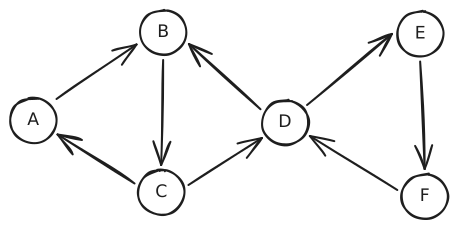
The paper also extends the swap protocol to arbitrary connected directed graph. A connected directed graph means for any two user $u, v$, there are a payment path from $u$ to $v$, and a payment path from $v$ to $u$. Such directed graphs contain loops, as in the example below:
\[
\begin{array}{rl}
V = \{&A, B, C, D, E, F\} \\
A = \{ \\
      &(A, B), (B, C), (C, A), \\
      &(C, D), (D, B), \\
      &(D, E), (E, F), (F, D) \\
    \} \\
\end{array}
\]
Leaders Selection
The protocol must select a Feedback Vertex Set of the directed graph as leaders. A feedback vertex set is a subset of $V$ that once removed from the graph, there will be no loops in the graph. For example, $(B, D)$ is a feedback vertex set of the example above. When there are multiple candidates, choose an arbitrary set.
The leaders generate secrets and publish their hashes. If $(B, D)$ are selected, they should publish $(H(s_B), H(s_D))$.
The protocol then move forward in two phases.
Phase One
In the first phase, users offer outbound contracts to counterparty for each payment.
Leaders must offer contracts first:
- Publish a contract on every outbound payments, then
- wait until all inbound contracts have been published.
Followers must confirm inbound contracts first:
- Wait until correct inbound contracts have been published, then
- publish a contract on every outbound payments.
The contracts are Hash Time Locked Contracts $(h, t)$ that payee can get the fund using the proof to unlock $h$, or the payer gets the refund after timeout $t$.
For a payment $(u, v)$, the proof of $h$ is a triple $(s, p, \sigma)$ where
$p$is any payment path$(u_0, \ldots, u_k)$starting from the payee$v$($u_0 = v$) to a leader$u_k$. The path$p$can have a length of 0 if$v$itself is a leader.$s$is the secret generated by the ending leader of the path$p$, and$h = H(s)$.$\sigma$is a nested signatures of$s$signed by users in the path$p$.- The innest signature is
$\mathrm{sig}_k = \mathit{sig}(s, u_k)$ - For user
$u_i$($0 \leq i \leq k - 1$), the signature is$\mathrm{sig}_i = \mathit{sig}(\mathrm{sig}_{i+1}, u_i)$ $\sigma = \mathrm{sig}_0$
- The innest signature is
The hash lock $h$ can be set to $H(s)$ for the shortest $p$, or just the hashes of all secrets to all unlocking using arbitrary ending leader of the path $p$.
The time lock $t$ is $(\mathit{diam}(\mathcal{D}) + |p|)\Delta$, where
$\mathit{diam}(\mathcal{D})$is the longest length of a payment path without duplicated users in the directed graph.$|p|$is the length of the path$p$in the hash lock.$\Delta$is a configured time unit constant for the time out.
Let’s see two examples.
The first example is the payment from a leader: $(B, C)$.
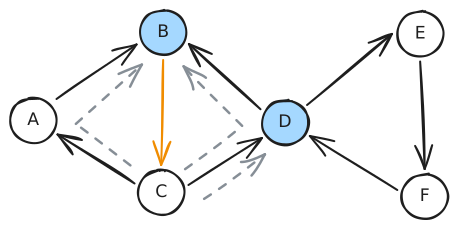
There are three candidate path $p$ from the payee $C$ to a leader either $B$ or $D$:
$(C, A, B)$$(C, D)$$(C, D, B)$
$B$ can choose any one, but the shortest one is recommended. Let’s use $(C, D)$. $B$ can publish the contract because he/she is the leader.
- The hash lock for
$(B, C)$is$H(s_D)$. - The time lock is
$6\Delta$, because the length of the longest path$(A, B, C, D, E, F)$is 5, and the length of$(C, D)$is 1.
The second example is the payment from a follower: $(C, A)$.
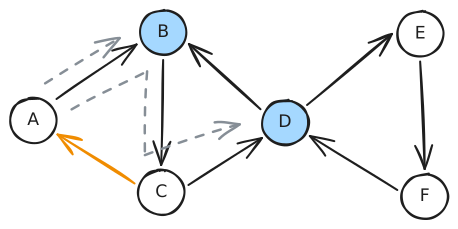
$C$ can choose the path $(A, B)$ and publish the contract:
- The hash lock is
$H(s_B)$. - The time lock is
$6\Delta$
Phase Two
In phase two, leaders can unlock the inbound contracts because they know all secrets. For example, the leader $B$ can unlock the inbound payment $(A, B)$ by offering:
- The path
$p = (B)$ - The secret
$s_B$ - The signature
$sig(s_B, B)$
Followers must trace outbound contracts unlocking events. For example, $A$ can unlock the contract for $(C, A)$ after receiving the unlocking event above:
- The path
$p = (A, B)$ - The secret
$s_B$since B has published it when unlocking$(A, B)$. - The signature
$sig(sig(s_B, B), A)$
Herlihy, M. (2018). Atomic Cross-Chain Swaps (No. arXiv:1801.09515). arXiv. https://doi.org/10.48550/arXiv.1801.09515 ↩︎